I found a page full of computations sitting around the house this evening. Naturally, I picked it up and gave it a look.
Griffin (10 years old, 5th grade) had been doing some multiplication in class today. Somehow his scratch paper ended up on our couch.
Here is one thing I saw.
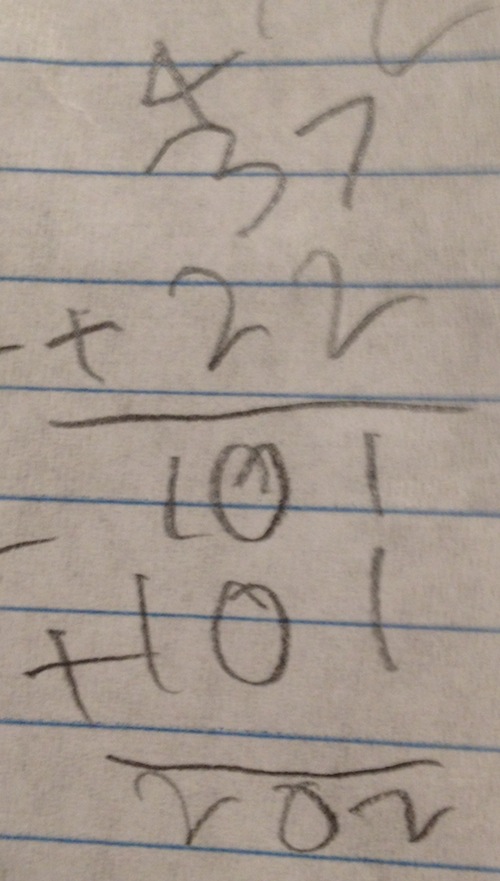
Naturally I wanted to ask the boy about it. He consented.
Me: I see you were multiplying 37 by 22 here.
Griffin (10 years old): Yeah. But I got it wrong so I did it again with the lattice.
Me: How did you know you got it wrong?
G: I put it in the answer box and it was wrong.
It turns out they were doing some online exercises. There is an electronic scratchpad, which he found awkward to use with a mouse (duh), plus his teacher wanted to be able to see their work, so was encouraging paper and pencil work anyway.
I was really hoping he would say that 37 times 22 has to be a lot bigger than 202. Alas he did not.
Anyway, back to the conversation.
Me: OK. Now 37 times 2 isn’t 101. But let’s imagine that’s right for now. We’ll come back to that.
G: Wait. That’s supposed to be 37 times 2? I though you just multiplied that by that, and that by that.
He indicated 7 times 2, and then 3 times the same 2 as he spoke.
Me: Yes. But when you do that, you’ll get the same thing as 37 times 2.
A brief moment of silence hung between us.
Me: What is 37 times 2?
G: Well….74.
Let us pause to reflect here.
This boy can think about numbers. He got 37 times 2 faster in his head than I would have with pencil and paper. But when he uses the standard algorithm that all goes out the window in favor of the steps.
THE STEPS WIN, PEOPLE!
The steps trump thinking. The steps trump number sense.
The steps triumph over all.
Back to the conversation.
Me: Yes. 74. Good. I like that you thought that out. Let’s go back to imagining that 101 is right for a moment. Then the next thing you did was multiply 37 by this 2, right?
I gestured to the 2 in the tens place.
G: Yes.
Me: But that’s not really a 2.
G: Oh. Yeah.
Me: That’s a 20. Two tens.
G: Yeah.
Me: So it would be 101 tens.
G: Yeah.
I know this reads like I was dragging him through the line of reasoning, but I assure you that this is ground he knows well. I leading him along a well known path that he didn’t realize he was on, not dragging him trailing behind me through new territory. We had other things to discuss. Bedtime was approaching. We needed to move on.
Me: Now. We both know that 37 times 2 isn’t 101. Let’s look at how that goes. You multiplied 7 by 2, right?
G: Yup. That’s 14.
Me: So you write the 4 and carry the 1.
G: That’s what I did.
Me: mmmm?
G: Oh. I wrote the one
Me: and carried the 4. Yeah. If you had done it the other way around, you’d have the 4 there [indicating the units place], and then 3 times 2 plus 1.
G: Seven.
Me: Yeah. So there’s your 74.
This place value error was consistent in his work on this page.
Let me be clear: this error will be easy to fix. I have no fears that my boy will be unable to multiply in his adolescence or adult life. Indeed, once he knew that he had wrong answers (because the computer told him so), he went back to his favorite algorithm—the lattice—and got correct answers.
I am not worried about this boy. He is and he will be fine.
But I want to point out…I need to point out that this is exactly the outcome you should expect when you go about teaching standard algorithms.
If you wonder why your kids (whether your offspring, your students, or both) are not thinking about the math they are doing, it is because the algorithms we (you) teach them are designed so that people do not have to think. That is why they are efficient.
If you want kids who get right answers without thinking, then go ahead and keep focusing on those steps. Griffin gets right answer with the lattice algorithm, and I have every confidence that I can train him to get right answers with the standard algorithm too.
But we should not kid ourselves that we are teaching mathematical thinking along the way. Griffin turned off part of his brain (the part that gets 37 times 2 quickly) in order to follow a set of steps that didn’t make sense to him.
And we shouldn’t kid ourselves that this is only an issue in the elementary grades when kids are learning arithmetic.
Algebra. The quadratic formula is an algorithm. Every algebra student memorizes it. How it relates to inverses, though? Totally obfuscated. See, we don’t have kids find inverses of quadratics because those inverses are not functions; they are relations. If we did have kids find inverses of quadratics, they could think about the relationship between the quadratic formula:
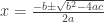
and the formula for the inverse relation of the general form of a quadratic:

Calculus. So many formulas (algorithms) that force students not to think about the underlying relationships. If we wanted students to really think about rates of change (which are what Calculus is really about), we might have them develop a theory of secant lines and finite differences before we do limits and tangent lines. We might have Calculus students do tasks such as Sweet Tooth from Mathalicious (free throughout October!). There, students think about marginal enjoyment and total enjoyment.
On and on.
This is pervasive in mathematics teaching.
The results are mistaken for the content.
So we teach kids to get results. And we inadvertently teach them not to use what they know about the content—not to look for new things to know. Not to question or wonder or connect.
I’m telling you, though, that it doesn’t have to be this way.
Consider the case of Talking Math with Your Kids. There we have reports from around the country of parents and children talking about the ideas of mathematics, not the procedures.
Consider the case of Kristin (@MathMinds on Twitter), a fifth grade teacher, and her student “Billy”. Billy made an unusual claim about even and odd numbers. She followed up, she shared, we discussed on Twitter. Pretty soon, teachers around the country were engaged in thinking about whether Billy would call 3.0 even or odd.
But standard algorithms don’t teach any of that. They teach children to get answers. They teach children not to think.
I have read about it. I have thought about it. And tonight I saw it in my very own home.





 Overthinking my teaching